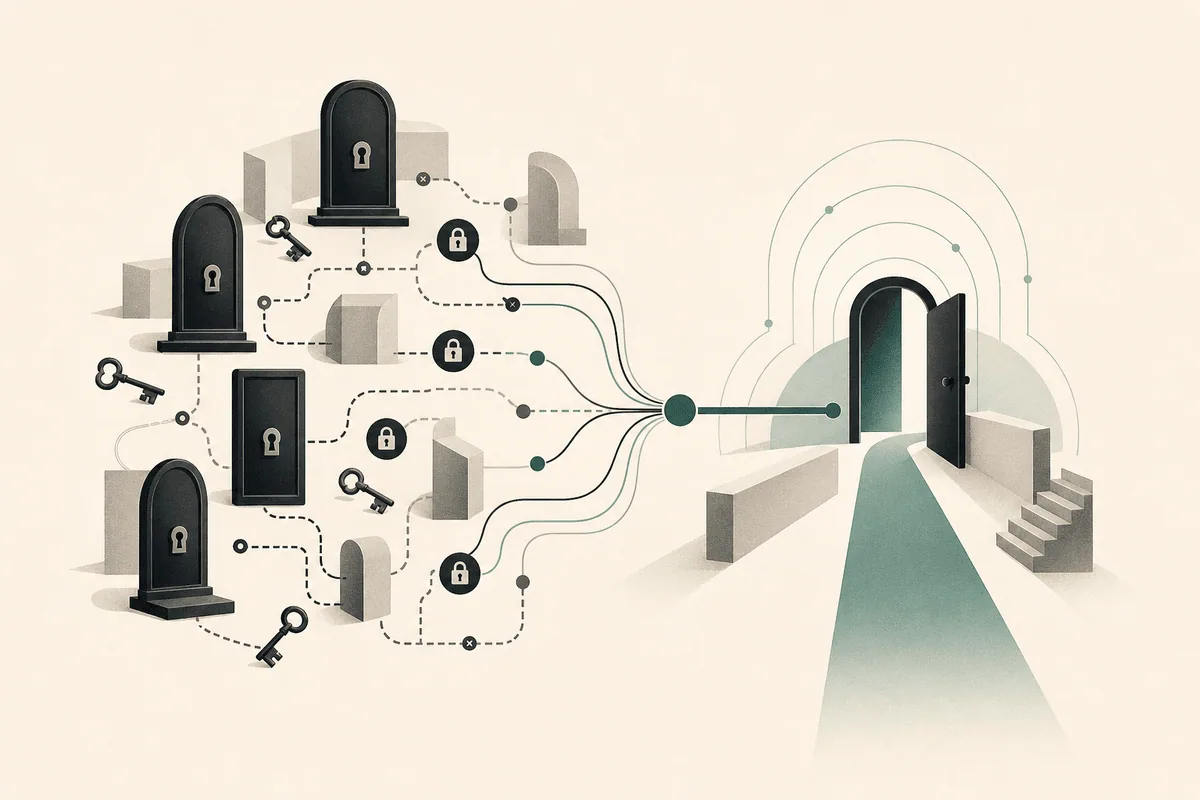
Treat Access as the First Field-Engineering Deliverable
The project channel went quiet after one calm question: who can create the document workspace for the demo? Nobody could. The design edit grant expired in three days, the access tracker was stale, and the only API credential had never been proved against the flows we were about to promise. The access readiness matrix is the field artifact that turns permission talk into delivery evidence.
An access readiness matrix is a delivery table that names each required system or capability, the owner, the credential path, the environment scope, expiration or revocation risk, proof of usable permission, and the escalation trigger. It treats access as evidence, not background administration.
TL;DR
An access readiness matrix shows whether a field team can actually discover, validate, and roll out inside the systems the work depends on. It records owners, credential paths, environment scope, least-privilege intent, expiration risk, proof artifacts, auditability, and revocation paths before dates harden. Without it, a sprint demo can look healthy while the project is quietly unable to move.
Access is not preflight. In field work, access decides whether the rest of the work can happen at all. Discovery becomes guessing when the team cannot reach the real system. Validation becomes theater when the account has never exercised the target workflow. Rollout becomes a calendar invite with a bad conscience when nobody can prove who can change what.
That sounds severe until you live through the smaller version: a basic-auth prompt appears exactly as expected, six content roles behave differently in the editorial workflow, and the demo looks composed. Then someone asks for a document workspace and gets blocked. Another person has a temporary design grant that expires in three days. A user credential exists for API exploration, but nobody has proved which flows it can exercise. The surface area is not huge. The failure mode is.
Why access belongs in the delivery plan
Forward deployed engineering has an awkward job shape. You are close enough to the customer environment to be useful, but not close enough to assume anything. Palantir describes the role as operating across customer problems, engineering, and deployment, which matches the hard part here: the work only becomes real when it touches the client environment. See their forward deployed software engineer role context for the public version of that shape.
The naive version treats access as a checklist item: request accounts, wait for approval, keep moving. That works only when the work is already understood and every system is stable, owned, and documented. In field work, that is a nice story we tell ourselves before opening the sixth login screen.
The better version treats access as a dependency map. Who has an account matters less than what the account proves. Can a content editor submit a page for initial review? Does that same editor lose edit access once the page is under review? Can the content manager approve without delete rights? Can the translator see only content in the translate state? Can the team open the findings document, create a new workspace, edit the design file after the temporary grant expires, and call the API with a user credential that resembles production reality?
Those are delivery boundaries. They belong in the plan.
A delivery plan that starts after access is already late. The quiet trick is to make access measurable enough that the team can argue about facts instead of vibes.
Building an access readiness matrix
The matrix I want is deliberately boring. If it requires special interpretation, it will rot. If it reads like a procurement artifact, engineers will ignore it. The useful version sits between a project tracker and an operating checklist.
It has one row per system or capability the field team must touch, and it separates I think I have access from I proved I can do the thing the project needs. That difference is where schedule risk hides.
| Area | Owner | Credential path | Environment scope | Expiration or revocation risk | Proof artifact | Escalate before |
|---|---|---|---|---|---|---|
| Editorial site | Platform owner | Account plus basic auth | Public and logged-in site | Low | Timestamped note that public and authenticated pages open | Sprint demo |
| Content roles | Platform owner | Six test users | Test or staging workflow | Medium | Moderation transition results by role, with denied actions recorded | Workflow signoff |
| Findings document | Client lead | Shared document link | Client collaboration suite | Medium | Link opens, comments work, edit access confirmed if required | Assessment review |
| Design file | Design admin | Temporary editor grant | Design workspace | High | Edit rights confirmed past grant window or renewal owner named | UI implementation |
| Document workspace | IT owner | Workspace permission | Project document space | High | Workspace created, or creator named with requested date | Planning session |
| API exploration | Identity owner | User credential | Approved API environment | Medium | Approved endpoint call succeeds as the intended user class | Integration estimate |
The column that matters most is proof. Has account is a weak signal. A note that says the editor created a draft, submitted it for initial review, and lost edit access is evidence. Can see the design file is weak. Can edit after the temporary grant window, or has a named renewal path, is evidence.
This is also where the matrix becomes political in the useful sense. It makes ownership visible without accusing anyone. A stale tools sheet stops being folklore and becomes a row with an owner, a status, and an escalation date. A three-day design grant stops being a surprise and becomes a risk with a clock.
For the same reason, I like pairing the matrix with a small decision trail. If access changes what the team can promise, capture that decision where the next person can find it. I use the same instinct in Turn Stakeholder Questions Into Demo-Ready Decision Records: the artifact should survive the meeting where it was created.
Split systems from capabilities
A common mistake is listing tools instead of the work the team must perform. Document workspace is a system. Create a new project document is the capability. Editorial site is a system. Move content from draft to initial review without edit rights leaking afterward is the capability.
The distinction matters because many projects have partial access. Partial access is worse than no access when it encourages false confidence. You can log in, so the tracker says green. Then the demo needs a role transition, a comment, a translation state, or a workspace creation step, and the permission boundary arrives right on time.
Name the environment scope
Access to staging is not access to production. Access to a sandbox API is not proof that the production identity model behaves the same way. Access to a design file is not access to the document workspace where decisions will be recorded.
Each row should say which environment it covers: local, sandbox, test, staging, production, client workspace, vendor console, or shared document space. If the row covers more than one environment, split it. Blended rows hide risk.
Environment scope matters most when the team uses test accounts. Test users are usually the right starting point because they avoid private credentials and reduce blast radius. They become dangerous when everyone forgets what they are allowed to represent. A test content editor can prove a moderation transition. It cannot prove that a real production editor has the same group mapping unless someone checks the identity path.
Prefer least privilege with a clock
Least privilege should not be a slogan that blocks delivery. It should be a concrete grant that lets the team do the needed work and no more.
For each row, name the smallest permission that proves the capability. Read-only may be enough for discovery. Editor may be needed for design validation. Workspace creator may be needed for one setup step and then should be removed. Admin should be rare, time-bound, and justified by a capability no narrower grant can perform.
This is where delivery speed and security can stop pretending to be enemies. A narrow, time-boxed grant with proof and revocation is usually faster to approve than a vague request for broad access. It also leaves a cleaner audit trail.
Treat temporary grants as active risks
Temporary access is often the right answer. The problem is recording it as stable access.
A three-day editor grant to a design file might be enough for a quick review. It is not enough for implementation if the team needs to inspect designs during build, answer edge-case questions, and validate revisions after feedback. The matrix should show the expiration window and the person who can extend or convert it. Otherwise the team discovers the risk when the file becomes read-only, which is a reliable way to waste an afternoon.
Require proof before dates
The rule is blunt: no external date depends on an unproved permission.
That does not mean every row must be complete before anyone works. It means the team does not promise a demo, assessment, or rollout that depends on a capability nobody has exercised. If the work needs API exploration with a user credential, prove the credential can authenticate and reach the approved surface before estimating integration time. If the work needs a new document workspace, prove creation rights or identify the person who can create it before the planning session.
This rule is uncomfortable because it turns a hidden dependency into an explicit delay. Good. Hidden delays do not shrink because they are socially convenient.
What proof should look like
Proof should be useful without leaking secrets. Do not paste credentials, tokens, session cookies, private client data, screenshots with sensitive fields, or full API payloads into the matrix.
Use proof artifacts that confirm the action and preserve auditability:
| Proof need | Useful artifact | Avoid |
|---|---|---|
| Login works | Timestamped note with environment and role | Passwords, recovery codes, session details |
| Role behavior works | Role transition checklist with allowed and denied actions | Screenshots exposing private records |
| API credential works | Endpoint name, status class, request ID if approved | Tokens, raw headers, sensitive payloads |
| Temporary grant is safe | Expiration date, renewal owner, revocation owner | Private admin console screenshots |
| Workspace access works | Created workspace link or named creator confirmation | Broad shared links with unknown audience |
Auditability is part of the proof. The team should be able to answer who granted access, what it allowed, what environment it touched, what action proved it, when it expires, and who can revoke it. If nobody can answer those questions, the row is not ready. It is a hope with a login attached.
Revocation belongs in the same conversation as approval. When the field slice ends, the temporary grant should have an owner and a removal path. If a one-time workspace creator permission was needed, remove it after setup. If an API credential was issued for exploration, confirm whether it stays for implementation, changes owner, or gets revoked. Cleanup is easier when it is planned before everyone moves on.
What changes in practice
The daily conversation gets sharper. Instead of asking whether we are waiting on access, ask which proof is missing. That phrasing forces specificity. It also keeps the team from treating all access problems as equal.
A public site guarded by HTTP basic auth has a different risk shape from role-specific content moderation. Basic auth is binary: the prompt appears, the credential works, and it persists once authenticated. Moderation permissions are behavioral: the same person may be allowed to create content, then correctly lose edit access after submission. Both are access, but only one can be tested with a single login.
Escalation also improves. Access blockers are often escalated too late because they are phrased too vaguely. We need access gives the owner work to interpret. We need a workspace creator or a created workspace by Thursday because the assessment review depends on it gives the owner a decision.
Cleanup gets less optional. The tools sheet in this project was the primary reference for granting access, but it also contained outdated or optional entries. That is not a moral failure. Shared trackers age. Mark optional rows, delete stale ones, and keep live requests in the path of the people granting permissions. A noisy tracker makes every valid request look like just another line item asking for attention.
Deep-dive: The access review I use
For each row, I ask eight questions:
- What project outcome depends on this system or capability?
- Which environment does the access cover?
- Who can grant, renew, or unblock access?
- What credential path does the team actually use?
- Is the grant least-privilege for the needed action?
- Does access expire, depend on admin review, or need revocation later?
- What artifact proves the needed permission without exposing secrets?
- What date should trigger escalation before the delivery date is at risk?
The last question turns the matrix from documentation into an operating tool.
Why this is a field-engineering artifact
A field-engineering artifact is produced by the team doing the work, changes how the work is executed, and can be inspected by the people depending on the outcome. The access readiness matrix qualifies because it shapes dates, scope, escalation, and cleanup.
A good version has a few properties.
| Property | What it prevents |
|---|---|
| Capability-level rows | Tool access marked green while the real action is blocked |
| Environment scope | Staging access mistaken for production readiness |
| Named owners | Channel archaeology when something expires |
| Least-privilege intent | Broad grants that are hard to approve or audit |
| Expiration and revocation path | Temporary grants masquerading as stable access |
| Proof artifact | Login mistaken for usable permission |
| Escalation date | Late surprises dressed up as unavoidable blockers |
There are costs. Maintaining the matrix takes time, especially in the first week when everyone wants to build. It can also feel bureaucratic if the team records every tiny permission instead of the capabilities tied to delivery. The line I use is simple: if losing this access can block discovery, validation, or rollout, it belongs in the matrix. If it is merely convenient, mark it optional or leave it out.
The approach also depends on client participation. A matrix cannot grant permission by existing. It can only make the missing owner, credential path, proof, and revocation path visible enough that the right person can act. That is still a large improvement over discovering the problem from a browser error five minutes before a working session.
Release work has the same discipline. Google SRE's release engineering chapter treats reliable rollout as a controlled, repeatable practice, not a final ceremony. Access deserves that posture earlier in the field cycle.
What I would escalate before promising a date
In this case, I would escalate four items before committing to a date.
The document workspace permission comes first. If the team cannot create or obtain a project document, the assessment and decision trail will fragment across chat, private notes, and stale links. Context will be in the thread until it is not.
The temporary design edit grant comes next. Three days is a timer, not a plan. Convert it to durable project access, or name the admin path for renewal before it expires.
The API exploration credential needs proof. A user credential is useful only after the team proves what it can reach, which environment it touches, and whether it represents the user class being tested. Otherwise the estimate rests on an identity assumption, and identity assumptions become production issues easily.
The editorial workflow role matrix needs negative tests. The demo may show the happy path, but the real validation is in the denied permissions: the editor who cannot edit after submission, the manager who cannot delete, the translator who sees only translate-state content. Access is not only what a user can do. It is also what they correctly cannot do.
Denial paths feel less satisfying than successful clicks. They still define the permission system. If the wrong user can perform the right action at the wrong time, the workflow is not configured. It is optimistic.
FAQ
Why is access readiness important for field engineering?
Field engineering depends on learning and validating inside real client systems. Access readiness shows whether the team can perform the actions needed for discovery, validation, and rollout before dates are promised.
What should an access readiness matrix include?
Use one row per required system or capability. Include owner, credential path, environment scope, expiration or revocation risk, proof artifact, and escalation trigger. The proof should be an action, not a claim that someone has an account.
How should proof of access be captured without exposing secrets?
Capture the action, role, environment, date, and approved evidence. Use request IDs, sanitized notes, links to non-sensitive artifacts, or role-transition results. Do not store passwords, tokens, cookies, private client data, or raw sensitive payloads.
How do temporary access grants create delivery risk?
Temporary grants create risk when they are treated as stable permissions. Record the expiration date, renewal owner, revocation owner, and dependent work before using the grant to support a delivery commitment.
When should access blockers be escalated?
Escalate before the dependent project date is at risk. Name the missing capability, environment, owner, requested action, proof needed, and date needed.
Access work feels administrative until the day it becomes the work blocking everything else.