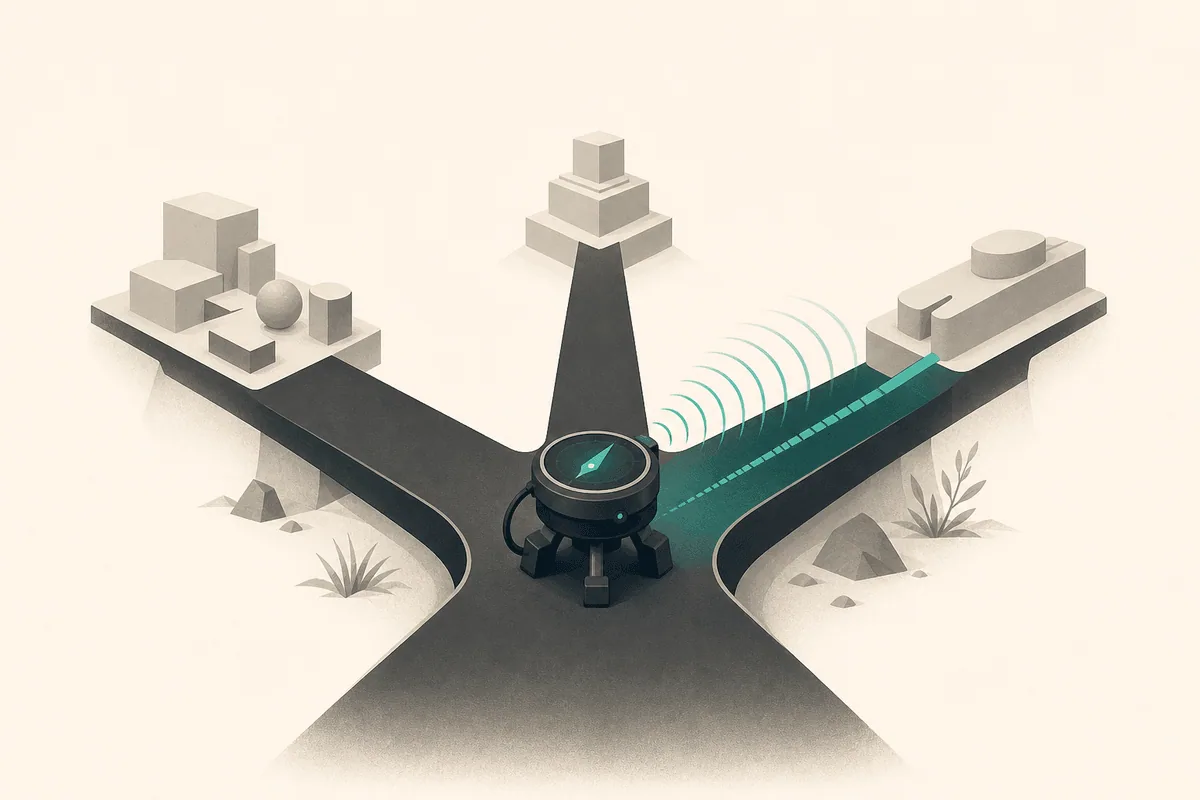
Use Production Feedback to Choose the Next Field Slice
I was looking at a release plan that had the usual pre-launch smell: QA was running the checklist, the team felt ready, and half the board was trying to become the next urgent thing. Two days before launch, the board looked ready and wrong at the same time. The better move was not to reward the loudest ticket. It was to ship 3.1, watch real search behavior in production, and use a production feedback field slice only where live signal could decide a 3.2 product bet without dragging the whole system into hardening too early.
TL;DR
Use production feedback to choose the next slice when the work can answer one product question from live behavior. The slice should be small enough to lose: tied to a real signal, attached to one workflow, reversible, bounded by a decision, and kept separate from hardening.
The five checks
I use this quick screen before I let a board item become discovery work:
| Check | Question it must answer |
|---|---|
| Signal | What production behavior will we observe? |
| Workflow | Which user job does the signal belong to? |
| Reversibility | Can we disable, narrow, or back out the change quickly? |
| Decision boundary | What will the evidence let us decide? |
| Deferred hardening | What are we intentionally not making permanent yet? |
That is the whole shape. If one of those answers is missing, the team may still have important work. It is just release work, reliability work, security work, or stakeholder follow-up rather than a production feedback field slice.
Why the loudest request was the wrong unit of planning
The sprint board did not lack activity. A social preview issue had been fixed by edge rule changes. A mobile build was waiting for staging validation. Several tickets were ready to release once testing cleared. One account creation flow needed a security rethink because it was auto-logging users in after signup. There was also an SEO rendering miss where some content had fallen outside server-side rendering.
That is a normal board. It is also a bad voting system.
If you choose the next slice by stakeholder volume, the work drifts toward whoever has the clearest complaint and the most convenient meeting slot. That may be useful customer service, but it is weak product learning. Field work should answer a question the product cannot answer safely from a conference room. That role context is part of why forward deployed engineering sits close to users and production constraints, not only implementation tickets, as Palantir describes in its forward deployed software engineer role.
For this release, the better move was to separate two kinds of work:
| Work type | What it needed | Why it should not drive the slice |
|---|---|---|
| Release readiness | Checklist, sanity testing, deployment confidence | It proves the release can go out, not what should be learned next |
| Browser preview fix | Production validation after edge rule changes | It was a resolved defect, not an open product question |
| Mobile build validation | Staging pass, build sharing, FYI communication | It needed completion discipline, not discovery |
| API revert | Restore alignment with non-prod behavior | It reduced risk, but did not create new product evidence |
| Search feedback | Real usage after production release | It could decide whether the 3.2 activation deserved investment |
The point was not that the other tickets were unimportant. Some of them were more urgent operationally. The point was that a slice is not a priority label. It is an instrument.
For access-heavy work, I use the same separation earlier in the engagement. I wrote about that in Treat Access as the First Field-Engineering Deliverable, because blocked access can masquerade as product ambiguity.
Production feedback field slice rubric
The rubric has five checks. The work does not need to be glamorous. It needs to be capable of changing a decision.
Live signal
The slice has to connect to something happening in production, not just a stakeholder's memory of what users probably do.
In this case, search feedback after the 3.1 release was the live signal. That matters because search behavior is easy to over-theorize. People say they want smarter search, broader matching, narrower matching, cleaner labels, and more control. Then production quietly shows whether they are actually searching by name, category, geography, misspelling, or desperation.
A concrete signal might look like this: after 3.1 ships, the team reviews seven days of production search sessions and sees that failed searches cluster around nearby-store intent. Users search for city names, neighborhood names, and misspelled store names, then either retry with a broader term or leave the flow. That is different from a general complaint that search is bad. It points to one workflow, one failure mode, and one possible 3.2 decision.
Start where the system can observe behavior that was previously argued about.
Affected workflow
A signal is not useful until it is tied to a workflow. Search feedback is vague until we ask what job search is doing.
Is it helping a user find a known item faster? Is it helping them discover something nearby? Is it rescuing a failed navigation path? Each answer implies a different product move.
That is why I would not turn all search feedback into a broad 3.2 activation plan. I would pick one workflow, such as finding nearby stores, and define what production feedback would count as evidence.
Reversible change
The next move should be small enough to undo without a ceremony.
That ruled out large schema changes, wide design changes, and API commitments that would be annoying to retract. It favored adjusted result ordering, limited copy changes, feature-flagged behavior, or a narrow activation path. This is where rollout discipline matters. Google's SRE book treats release engineering as a discipline of repeatable, controlled delivery, and Martin Fowler's feature toggle guidance is useful context for keeping activation reversible instead of permanent by accident.
The mobile API work on the board was a useful reminder. A feature flag stayed disabled because the API path was not ready to proceed, and one group needed an API revert to restore alignment. That is what happens when a probe quietly becomes a platform promise. The work stops being learning and starts being a tax.
Slices are valuable because they are allowed to be temporary. The moment one needs the organization to preserve it permanently, it has become product hardening.
Validation boundary
Before the work goes live, I want the team to know what decision it will make.
Not a vanity metric. Not a dashboard tour. A decision.
For search feedback, the validation boundary could be stated plainly:
| Decision | Evidence that supports it | Evidence that rejects it |
|---|---|---|
| Activate the 3.2 search improvement for one workflow | Production queries cluster around that workflow and failed searches have a plausible fix | Queries are scattered, low volume, or driven by content gaps outside the feature |
| Keep the feature disabled | Feedback shows unclear demand or operational risk | A repeatable workflow appears with low implementation risk |
| Harden for wider rollout | The slice improves the chosen workflow without creating support noise | The fix works only under narrow conditions or creates confusing edge cases |
Teams often cheat here. They say they are validating, but the decision has already been made. The field work becomes theater, with charts.
The validation boundary should be uncomfortable enough that the team can lose the argument.
What waits for product hardening
The fifth check is restraint. Some work belongs after the decision, not inside the slice.
For this story, product hardening would include broader UX cleanup, deeper analytics taxonomy, cross-platform parity, long-term API shape, and full operational documentation. Those things matter. They also make poor probes because they increase cost before the team knows which behavior is worth supporting.
I like writing a short wait list before the work starts:
| Wait until validated | Reason |
|---|---|
| Full search redesign | Too broad for one production question |
| Permanent API expansion | Hard to retract once mobile clients depend on it |
| Complete analytics taxonomy | Useful after the workflow is known |
| Cross-platform activation | Multiplies QA before demand is proven |
| Polished admin controls | Premature if the behavior may be discarded |
A wait list is not a backlog graveyard. It is a pressure release valve. It lets a team say, with a straight face, that the work is real but not yet owed.
The board made the decision clearer
The surrounding tickets helped by showing which work should be sorted elsewhere.
The preview issue was fixed through edge rules and needed production validation. Good release hygiene. No product bet required.
The mobile issues had a production build already generated, staging validation underway, and a plan to share the build once covered fixes were confirmed. That needed crisp communication: what changed, what was included, and why no formal client UAT was required. Useful work. Not discovery.
The SEO rendering miss was a quality gap. Some things were not server-side rendered and fell through. The fix sounded small and budget impact looked limited. That belongs in the reliability lane.
The account creation flow was different. Auto-login after account creation had been flagged as a security concern, and that sort of issue should interrupt product curiosity. A slice does not get to hide security debt by calling itself learning.
This is the unromantic part of planning from production feedback: a good rubric disqualifies most candidates.
The cost of this approach
This way of working has a real cost: it can feel slower than just picking the biggest visible feature and pushing it through.
Stakeholders sometimes hear "field slice" as a polite delay. Engineers can hear it as scope churn. Product managers can misuse it as a way to avoid committing. Those are fair risks.
The antidote is specificity. The work must name the signal, the workflow, the reversible change, the validation boundary, and the hardening that is intentionally deferred. If any of those are missing, the team is probably just renaming uncertainty.
There is also a political cost. The loudest stakeholder may be right. The rubric does not prove otherwise. It only asks whether their request is the next best way to learn from production. Sometimes the answer is yes. In this case, search feedback had the stronger claim because it could decide the shape of 3.2 activation before the team spent itself making the wrong thing sturdy.
How I would run the next slice
I would run the 3.1 release as planned, with QA completing the pre-deployment checklist and sanity testing. I would not bundle the search decision into the release conversation. That keeps readiness separate from learning.
Then I would review production search feedback on a short clock. Not a forever dashboard. A defined review window with enough volume to see patterns, paired with examples of failed searches and successful recoveries.
The candidate would need to pass this checklist:
- Does the signal come from production behavior, not a meeting note?
- Does it affect one named workflow?
- Can the change be disabled, reverted, or narrowed quickly?
- Does the team know what decision the evidence will make?
- Is product hardening explicitly deferred until the decision is made?
If the answer is no, the work might still be worth doing. It just should not be sold as field discovery.
Deep-dive: The one-page slice brief
A useful slice brief is short enough to fit in the release channel without becoming a document people ignore.
| Field | Example |
|---|---|
| Slice | Improve search results for /stores/nearby discovery |
| Signal | Production search terms and failed-result sessions after 3.1 |
| Workflow | User tries to find a nearby store from search |
| Change | Feature-flagged result ordering adjustment |
| Validation boundary | Decide whether to activate this workflow in 3.2 |
| Revert path | Disable the flag and return to current ordering |
| Hardening deferred | Search redesign, permanent API changes, cross-platform rollout |
The brief is not there to impress anyone. It exists so the team can point to one page when the slice starts attracting unrelated wishes.
FAQ
Why is the loudest stakeholder a bad way to choose the next slice?
A loud request may identify pain. It does not automatically identify the next best product decision. Choose the work because it can turn production feedback into evidence.
Where should I capture production feedback?
At the workflow boundary where the user is trying to complete a job. For search, that means production queries, failed-result sessions, and the path users take after search.
What makes the work reversible?
It can be disabled, narrowed, or backed out without breaking downstream commitments. Feature flags, limited activation, and small content or ranking changes usually beat permanent API or schema changes.
What should wait until product hardening?
Anything that assumes the decision is already proven: broad redesign, permanent API expansion, cross-platform rollout, full analytics taxonomy, and admin tooling.
How do I know the slice worked?
The team can make a clear product decision after it: activate, narrow, revert, or harden. If the result is only more discussion, the validation boundary was probably too weak.
A release can prove the system is ready. Production feedback proves whether the next bet deserves to become real.