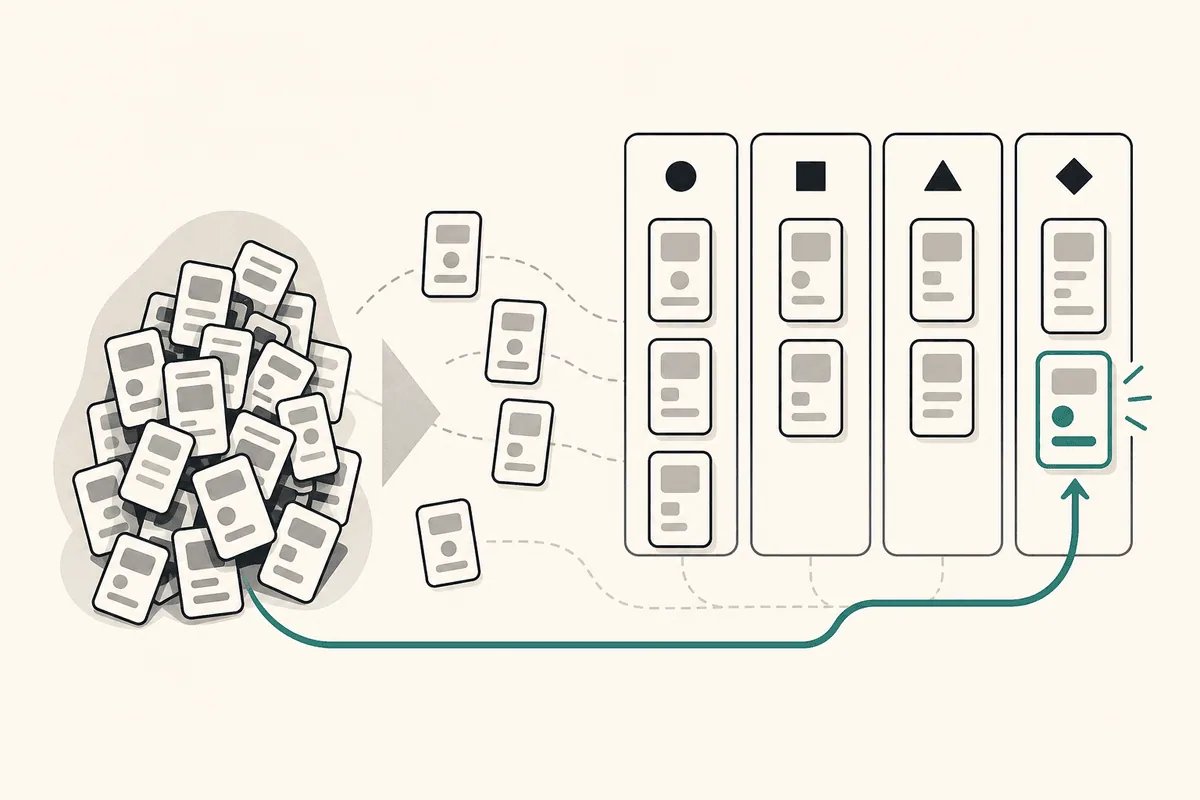
Turning a Mobile Backlog Into a Client Decision Artifact
At 4:30 p.m., fifteen items were still parked in Discuss, and the client call was close enough that every vague note had become a liability. Payments carried commission risk, identity had duplicate-account questions, the card sort had no responses, and nobody could yet say which choices belonged to the client. Mobile backlog decisions work best when each open item has a routing outcome, not only a priority label.
A harder prioritization debate would not have fixed that. We needed to separate delivery calls from client tradeoffs, safe delays, and product questions. Preferences and cart work could move inside existing epics. Payments needed a business decision. The locator pause needed a definition. Card sort dependencies needed dates and fallback paths.
TL;DR
A mobile backlog becomes useful in a client call when each open item has a routing decision: Proceed, Sign off, Defer, or Product input. The board should show where client judgment changes the delivery path, while ordinary delivery details stay with the team.
A field delivery lead should not hand the client a pile of preferences and call it transparency. The job is to translate ambiguity into accountable choices.
That work was not neat. It involved user flow diagrams, a midpoint sync, a prioritization call, open monetization questions, separate identity systems, design ownership gaps, and a card sort timeline that was already slipping. The backlog was not wrong. It was carrying too many kinds of uncertainty in the same column.
The change was practical: stop treating the backlog as a feature inventory and start using it to route judgment.
Why routed mobile backlog decisions beat backlog opinions
The backlog had three visible buckets: Now, Discuss, and Later. That was a decent planning view. It was weak as a decision view.
Now can still hide unresolved feasibility. Discuss can collect anything people are nervous to classify. Later can hide whether the delay was accepted, assumed, or never discussed.
The mobile app itself was not small. The work included identity and account unification, profile preferences, certification and activity logging, commerce and payments, content flows, menu structure, visual language, and anonymous versus logged-in user journeys. Some items were normal implementation detail. Others required a design call, research evidence, or a business tradeoff. Platform constraints also mattered, including app store commissions on in-app digital purchases.
Bringing all of that into a client call as a card-by-card walkthrough would have looked thorough and wasted the room. Clients do not need every internal wrinkle. They need to know where their decision changes scope, launch posture, cost, risk, or timing.
So we reshaped the artifact around decision type, not feature type.
The call became a review of decisions instead of a tour through scope.
The routing matrix
The board worked because each item had to pass through the same routing rule. That kept Discuss from turning into a holding pen for unrelated problems.
| Route | Use when | Evidence threshold | Client role | Example output |
|---|---|---|---|---|
| Proceed | The delivery team can decide within agreed constraints | Existing epic, known owner, no unresolved client tradeoff | Review by exception | Continue under current scope |
| Sign off | A recommended path exists, but it changes launch value, business posture, customer expectation, or operational risk | Clear recommendation, named tradeoff, decision date | Accept or reject the tradeoff | Approve the launch path or choose an alternative |
| Defer | The item is outside the current launch path and the cost of delay is understood | Known non-critical dependency, no client surprise, revisit trigger | Acknowledge the delay if needed | Remove from current call agenda with rationale |
| Product input | The item is useful evidence, but the team lacks product semantics, research evidence, or roadmap ownership | Open definition, research dependency, or future-system implication | Clarify direction or assign product follow-up | Feed roadmap, research, or design system work |
The rule is simple. If the delivery team can decide inside already agreed constraints, proceed. If the client owns the tradeoff, ask for sign-off. If delay is safe and understood, defer. If the question is really about product meaning or evidence, route it to product input.
This is close to the discipline behind architecture decision records: decisions need context, consequences, and a durable record, not just a meeting memory. Cognitect's short reference on documenting architecture decisions is still a useful anchor for that habit. I use the same instinct in client work, including the approach in Turn Stakeholder Questions Into Demo-Ready Decision Records.
When routes conflict
The matrix is only useful if the lead is willing to handle awkward cases.
An item can look like Product input and still need Sign off. Identity was like that. The product question was how the system should treat a person with records in two account pools. The client decision was whether that risk blocked launch. In that case, the sign-off route wins for the launch call, and the product question becomes a follow-up with an owner.
Evidence can also arrive late. The card sort had no submissions yet, and results were expected after the current review window. We did not freeze the build around missing research. We marked evidence-bound choices, gave them a date, and kept only the parts that did not depend on the study moving through design review.
Client non-decisions need a recorded outcome too. If the client will not decide, the board should not sit in Discuss forever. The lead should write the default path, the risk of using it, the date it becomes binding, and the person who can still override it.
Product input is the easiest route to abuse. It should not become a polite junk drawer for anything the team finds hard to settle. If an item has no roadmap owner, research question, design-system implication, or future operating decision, it probably belongs in Proceed, Sign off, or Defer.
Applying the matrix
Payments looked like one topic, but it contained two different routes.
Profile preferences, payments, and cart concerns had been flagged by the client ahead of the call. The first instinct in a messy backlog is to add each one as a new agenda topic. We checked whether they were already embedded in existing epics.
They were. Preferences belonged in profile and account work. Cart belonged in commerce. Payments belonged under monetization, which was already an open discussion item. That meant preferences and cart could proceed as part of existing scope. They still needed owners and review points, but they did not deserve fresh client-call time.
Payments for digital purchases were different. App store commission exposure could change the commerce architecture and business model. That is a client tradeoff, not an implementation detail. The route was Sign off: decide whether mobile payments for digital purchases remain in the app for launch, or move to a web-based purchase path for the first release.
Identity also split across routes. Separate account systems meant the same email could exist twice with different records. If the question was how to label a field or place an entry point in the prototype, the team could proceed under design review. If the question was whether duplicate accounts blocked launch, that needed sign-off. The recommendation had to say whether account merge was launch-critical, what user flow depended on it, and what operational risk remained if it shipped later.
The locator feature tested the Defer route. The client had indicated work was paused, but the scope was unclear. A pause is not the same as a defer decision. The board needed to record what paused meant: excluded from launch, waiting on another team, or still expected as a template input. Until that meaning was clear, the item stayed in Discuss and moved toward either Sign off or Defer.
The card sort belonged mostly in Product input. No submissions had come in yet, the cutoff had moved from June 14 to June 17, and results were still expected by June 19. The current build did not need to stop, but choices that depended on that evidence needed a date and a fallback. Menu structure, segment naming, and default paths for anonymous users could proceed only where they did not depend on missing research. Anything that depended on the card sort stayed marked as evidence-bound product input.
The decision-board template
Here is the template I would use again. It has to be scannable during a call, while people are also listening, checking constraints, and deciding what they can commit to.
| Field | What it captures | Example entry |
|---|---|---|
| Epic | The feature area or customer journey | Identity and profile |
| Item | The specific decision or ambiguity | Same email in two account pools |
| Current state | Proceed, Discuss, Sign off, Defer, or Product input | Sign off |
| Recommendation | The team position | Treat account merge as launch-critical |
| Client decision needed | The exact decision requested | Confirm whether duplicate accounts block launch |
| Rationale | Why this matters | Same user may have conflicting records |
| Dependency | What is waiting on this | User flow diagram and auth scope |
| Owner | One accountable person | Delivery lead |
| Due date | When the decision is needed | Before midpoint sync |
| Evidence | Linkable support | Prototype note, research result, platform policy |
| Outcome | Filled live or after the call | Approved for launch path |
The field that matters most is Client decision needed. If that cell cannot be written as a real decision, the item is not ready for the call.
Bad entry: Discuss payments.
Better entry: Decide whether mobile payments for digital purchases remain in the app for launch despite platform commission exposure, or move to a web-based purchase path for the first release.
That sentence is less comfortable. Good. It exposes the actual choice.
Important
A decision board is a filter for which uncertainties deserve client time and which should be resolved by the delivery team.
How we used it before the call
We shared the artifact ahead of time so the client could self-review Proceed items. That gave the meeting a controlled agenda.
The call started with open points that could change the launch path. Monetization came early because commission exposure could affect architecture and business posture. Identity came early because duplicate accounts could affect flows, data ownership, and support expectations.
Internal disagreement also got easier to handle. If someone thought a flow was not feasible, the board forced the concern into a route: delivery decision, client tradeoff, safe delay, or product input. That is more useful than a comment thread that says the flow feels complicated.
The board stayed tied to the working systems. Jira carried delivery execution. Figma carried design review and prototype comments. The decision board carried route, owner, evidence link, and next date. If those sources drift apart, the board becomes another tracker. If they stay synchronized, the team can use it without re-litigating the source of truth during the call.
What we cut from the meeting
We cut the full feature walkthrough. It would have burned time on items that did not require a decision.
We cut pure Now, Next, Later as the client-facing structure. It was still useful for planning, but it did not show accountability.
We cut research delays as a side note. The card sort and pro sort work had timing risk, so dependent decisions needed a fallback path.
We held design artifacts until internal review was complete. User flow diagrams had already surfaced feasibility questions, including anonymous states and definitions of user segments. Sending those out too early would have turned internal uncertainty into client confusion.
Rollout discipline matters here. Release engineering work is partly about making change understandable, staged, and recoverable. Google's SRE chapter on release engineering is about software release systems, but the same delivery habit applies here: do not let unresolved risk arrive late as a surprise.
The limitation
This approach does not remove judgment. It makes judgment visible.
That has a cost. The recommendation has to be written. The route has to be defended. The board has to be updated after workshops, dry runs, emails, prototype reviews, and prioritization calls. If the board is stale, it carries authority it has not earned.
There is also a political edge. A decision board can expose when the team has been using client ambiguity as cover for internal indecision. That is uncomfortable. It is still cheaper than discovering the problem during launch planning.
The board has to stay small enough to govern. Minor preferences should not become sign-off items. The lead has to protect the distinction between a client decision and an implementation detail.
What changed in the room
The spreadsheet was not the point. The question changed.
Before the board: What do we have?
After the board: What decision is missing?
That shift changed the meeting. We could say what was moving, what needed a decision that day, what was deferred with rationale, and what had been routed into product input. The client had a cleaner choice. The delivery team had a record. Product and design had usable input instead of meeting folklore.
A mobile backlog can be messy in the middle. It should reach the client as a set of decisions, not a mess with better formatting.
That is the practical value of mobile backlog decisions: the unresolved question becomes visible before the client call, while there is still time to route it.
The point of mobile backlog decisions is to make the client-facing choice visible before delivery treats it as engineering fact.
FAQ
How do I turn a backlog into client decisions?
Route each item as Proceed, Sign off, Defer, or Product input. Then write the exact decision needed, the recommendation, the rationale, the owner, the due date, and the evidence.
Why is Now, Next, Later not enough?
It describes timing. It does not show whether the client accepted a tradeoff, whether the team can proceed independently, or whether more discovery is required.
Where should design feasibility questions go?
Put them on the decision board when they affect scope, launch value, or client expectations. Keep ordinary execution details inside the design workstream.
What belongs in Product input?
Questions that should inform roadmap, research, definitions, or design systems but should not block the current release. Segment definitions, future content strategy, and unvalidated workflow ideas often fit there.
How do I keep the board current?
Update it after each call or review. Each open item needs an owner, a date, and a next moment of truth. If it has none of those, it probably does not belong on the board.
How many mobile backlog decisions should go into a client call?
Only the ones where client judgment changes the path. Proceed items can go in the pre-read, Defer items need rationale, and Sign off items need the clearest airtime.