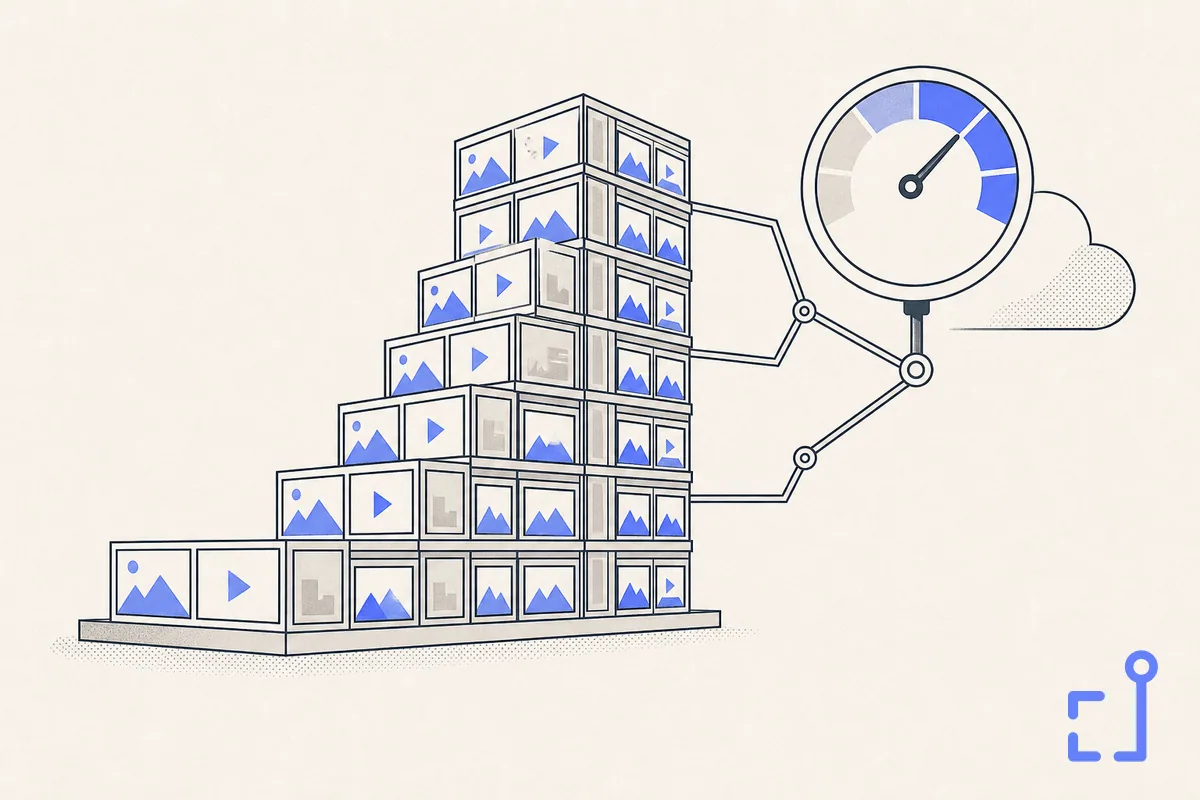
Your DAM bill grows with your library. Your library only grows.
The first cost model I wrote for dam.rs exposed a perverse rule: the outcomes a DAM is bought to produce all pushed the bill higher. As more people found the work, more originals survived and approved renditions reached more sites. In DAM pricing, a healthy digital asset library could look identical to an expensive one.
TL;DR
DAM pricing often scales with seats, asset count, stored bytes, and delivery traffic, while a useful archive grows across all four. A durable model separates fixed operating costs, marginal consumption, and commitment proxies. Storage ownership, searchable cold originals, and portable metadata do not make a DAM free, but they stop retention and exit from becoming the vendor's leverage.
This is not an argument that every hosted DAM is overpriced. A small team can sensibly pay someone else to operate the database, media pipeline, security updates, and support desk. The problem appears when pricing remains tied to commitment as the product succeeds by deepening that commitment.
Why DAM pricing conflicts with the product's mission
A DAM exists because files accumulate faster than people can remember where they put them. A successful year brings new campaigns and product launches, work across territories, and a growing trail of releases and revisions. The archive grows because the organisation is working, not because somebody forgot to clean it.
Four meters commonly appear in commercial plans. None is irrational by itself. Their combined effect is the issue.
| Meter | What the invoice observes | What the organisation starts doing |
|---|---|---|
| Named seats | How many people can enter | Share logins, exclude agencies, or route work around the DAM |
| Asset count | How many records remain | Delete old work before its future value is known |
| Stored bytes | How much quality and history is retained | Drop RAW files, mezzanines, or previous versions |
| Delivery traffic | How much the library is reused | Cache outside governance or send files through side channels |
Those responses damage the properties that justified buying a governed system. Shared credentials weaken attribution. Files sent through email and generic file shares escape rights checks. Deleting an old model release can remove the evidence needed to explain why an image was used. A pricing limit becomes an architecture decision, usually without an architecture review.
This mapping shows relationships, not one-to-one cost allocation. Asset count can genuinely increase index size, search work, database storage, and backup duration. It can also serve mainly as a proxy for how much work the organisation has entrusted to the product. The same distinction applies to seats and traffic. Identity administration has fixed and variable costs, but a temporary read-only user rarely creates marginal cost equal to a full-seat tier.
A useful model separates four quantities:
- Fixed cost: the database baseline, monitoring, support coverage, and minimum compute.
- Marginal cost: object storage, network bytes, restore requests, model tokens, and incremental compute.
- Commitment proxy: seats or asset count used to estimate willingness to pay rather than direct consumption.
- Migration surface: stored objects, metadata semantics, identifiers, integrations, and delivery URLs that must survive an exit.
The inspectable model is not automatically cheaper. Its advantage is reconciliation. Storage charges can be traced to object placements and classes; database charges to queries, backups, and compute. A per-seat tier is harder to connect to marginal cost.
Deletion is not a complete cost-control policy
Retaining less works for disposable material. A governed library also contains records whose useful life differs from the campaign that created them.
Rights evidence outlives current use
In a dispute, the question is often whether the organisation had the necessary licence and releases when it used an image two years earlier. Deleting that evidence because the creative is inactive turns a storage saving into an evidentiary gap.
dam.rs models rights as data with its own lifecycle. Licences, scopes, releases, intended-use declarations, and consumption records do not collapse into one badge on the asset row. A legal hold can block distribution and deletion independently of ordinary retention.
Provenance is a graph, not a label
A web rendition may descend from a retouched master, which may descend from a camera original with a detached credential and transformations between them. Removing an intermediate record can leave the output bytes intact while making their provenance incomplete.
Historical versions answer future questions
Version history looks redundant until someone asks which logo was approved for a market, which crop a partner received, or whether an image predates a withdrawal. "Nobody opened it recently" does not mean "nobody will need to establish what happened."
Deletion belongs in the system, but it needs policy, holds, review, and an audit record. Using it as the main response to a pricing tier delegates those decisions to the invoice.
Exit cost compounds with tenure
Annual licence cost is visible. Exit cost stays hypothetical until the organisation tries to leave, when the library is largest and integrations are most numerous.
Bytes have to cross a boundary
If the vendor stores the masters, migration begins with full egress. Derivatives may be reproducible, but doing so requires the transform definitions, colour profiles, codecs, and versioned behaviour that created them. Pulling existing renditions may be safer and also multiplies the bytes that must leave.
Metadata values are easier to export than semantics
A CSV can contain editorial, WORLD, and approved without preserving the rules that made them meaningful. It may omit whether exclusions override inclusions, which deprecated vocabulary terms remain resolvable, or whether approval applies to an asset, a version, a channel, or a portal.
That distinction shaped dam.rs. Its data model stores licence scopes, exclusions, validity windows, release status, declared use, and the resulting consumption ledger. The goal is an export that preserves decisions rather than only strings.
URLs become dependencies
CMS pages, partner portals, feeds, and design tools reference delivery URLs. A migration must rewrite those references or maintain a redirect and compatibility layer. As the DAM becomes more useful, more callers depend on its identifiers.
The lock-in mechanism is the expanding migration surface. A negotiated discount changes the current invoice but does not reduce the objects, semantics, identifiers, and integrations involved in leaving.
Measure consumption as levels and flows
An operator still needs to know what a tenant consumes, and hard limits are appropriate for some variable-cost operations. The useful meters correspond to work performed by the system or provider.
dam.rs separates levels from flows:
- A level is a current state, such as asset count or bytes stored by class.
- A flow is an event during a period, such as downloads, restore bytes, or model tokens.
Today's storage level cannot be reconstructed accurately for an arbitrary day last March unless the system captured it then. Download events can be counted later because each has a timestamp.
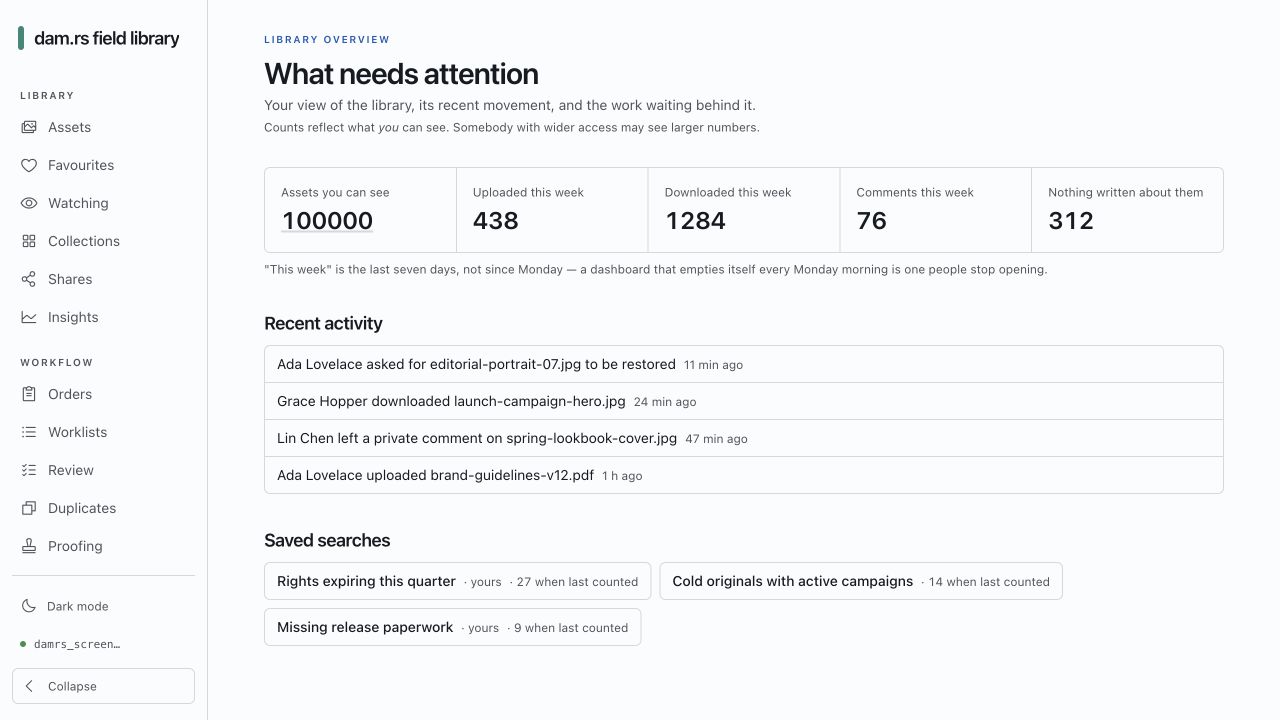
The dam.rs dashboard with representative development data. Each count is scoped to the current caller, while levels and flows remain separate measurements.
The metering query reads the current placement table for storage and the event ledgers for daily activity:
SELECT storage_class,
       coalesce(sum(size_bytes), 0)::bigint AS stored_bytes
FROM object_placements
WHERE state = 'present'
GROUP BY storage_class;

SELECT count(*) AS downloads
FROM rights_usage
WHERE source = 'download'
  AND recorded_at::date = $1;
The daily row is upserted on (tenant_id, day). Re-running a metering job replaces the measurement instead of adding it again. A worker retry should correct a report, not create a second invoice.
Important
Metering must use the operator's full tenant view, not the requesting user's filtered view. A curator who may see 30 percent of a library still belongs to a tenant storing 100 percent of its bytes. Using an access-scoped count for billing would make the same tenant have several different bills.
Each quota unit can choose soft or hard enforcement. Hard caps are reasonable for optional AI enrichment or restore spend. They are dangerous for ingest because refusing an upload can strand active production work. One global "over quota" switch cannot express that distinction.
Storage ownership changes the cost curve
dam.rs puts originals and derivatives in an S3-compatible bucket selected by the operator. Metadata lives in Postgres, and search indexes can be rebuilt from that database. The application coordinates those systems without owning the storage account.
Large originals can move to an archive class while searchable metadata, thumbnails, and proxies stay hot. Cost then follows byte temperature instead of charging the same rate for a rarely opened master and a frequently rendered thumbnail.
The organisation still pays for requests and network transfer, but those charges are visible in its cloud account. Existing commitments, a CDN, another object-store provider, or a regional design can change the bill without a licence renegotiation.
Stopping the application also does not trigger a bulk export of the objects. They are already in the operator's chosen account. Migration still requires preserving metadata semantics, replacing integrations, and building another delivery layer, but it does not begin by buying back every byte.
Build a cost model that survives operations
I would compare hosted and self-operated DAMs over at least three years using five categories:
| Category | Hosted model | Storage-owning model |
|---|---|---|
| Product fee | Subscription, tiers, overages | Software support or engineering |
| Infrastructure | Often bundled and opaque | Database, object storage, compute, CDN |
| Operations | Vendor-operated | Backups, upgrades, monitoring, incidents |
| Governance | Configuration and process | Configuration, process, and code ownership |
| Exit | Export, egress, remapping, URL migration | Metadata and integration migration |
For year t, I would model total cost as:
T(t) = F(t) + S(t) × p_s + E(t) × p_e + Q(t) × p_q + O(t) + X(t)
Here, F is fixed product and infrastructure cost, S is stored bytes by class, E is egress or delivery traffic, Q covers other metered operations, O is operating labour, and X is the estimated exit work accumulated by that year. Seats and asset count belong in the formula only where they change real work or the commercial fee.
Run the formula against distinct growth shapes. One case might keep storage and delivery nearly flat. An expected case might grow both together. A retention-heavy case would accumulate originals and versions faster than delivery traffic. These are illustrative shapes, not universal forecasts. The inputs should come from the organisation's own ingest, retention, access, and staffing data.
Self-hosting labour cannot be priced at zero. Postgres needs tested restores. Object-store policy needs review. Signing keys and KMS keys need rotation. Media tooling needs security updates. Someone must respond when a worker queue stops advancing at 02:00. Once those costs are included, a hosted service may be cheaper.
The decision turns on which capability is scarce. Buying the service is rational when the library has ordinary rights requirements and the team lacks a dedicated operator. Owning the data plane can justify the operational load when storage class, retention, data residency, enforced rights, or exit cost are strategic constraints.
What we rejected
Keeping everything in Standard storage makes retrieval simple but charges the warm rate for masters that become colder every month. Archiving old assets outside the DAM cuts the main system's bill by creating a second library with weaker search, rights, and provenance. Users then keep local copies of anything they may need quickly, leaving the organisation to pay for cold storage and an ungoverned warm shadow.
The practical design keeps the asset record and browsing substrate online while changing only the latency of the original bytes. Getting that state model wrong turns a cheap object into a missing asset.
FAQ
Is a self-hosted DAM always cheaper than SaaS?
No. Small libraries often benefit from a hosted service because specialist operations, upgrades, and support are bundled. Self-hosting becomes compelling when storage, retention, rights enforcement, residency, or exit control outweigh the cost of operating the stack.
Which DAM pricing metric creates the most lock-in?
Stored bytes and asset count create visible growth, but metadata semantics and integration URLs usually make an exit hardest. Those dependencies grow quietly and cannot be solved by downloading the masters alone.
Should old digital assets be deleted to control cost?
Only under an explicit retention policy that accounts for rights evidence, legal holds, provenance, and historical versions. Recent access is useful input, but it is not a sufficient deletion rule.
What should a DAM meter instead?
Meter inspectable consumption: current bytes by storage class, database and compute load, network transfer, restores, and other variable-cost operations. When the bill follows work the system actually performs, library growth remains an operational fact instead of becoming a penalty for trusting the product.