The green badge is not permission
The rights screen was already green when I found the hole. The asset had a valid licence. The territory matched, and the download control looked correct. Yet DAM rights enforcement still had a gap. I followed the URL instead of the interface and reached the more important question: what recomputes that answer when the licence changes after the URL has been issued?
TL;DR
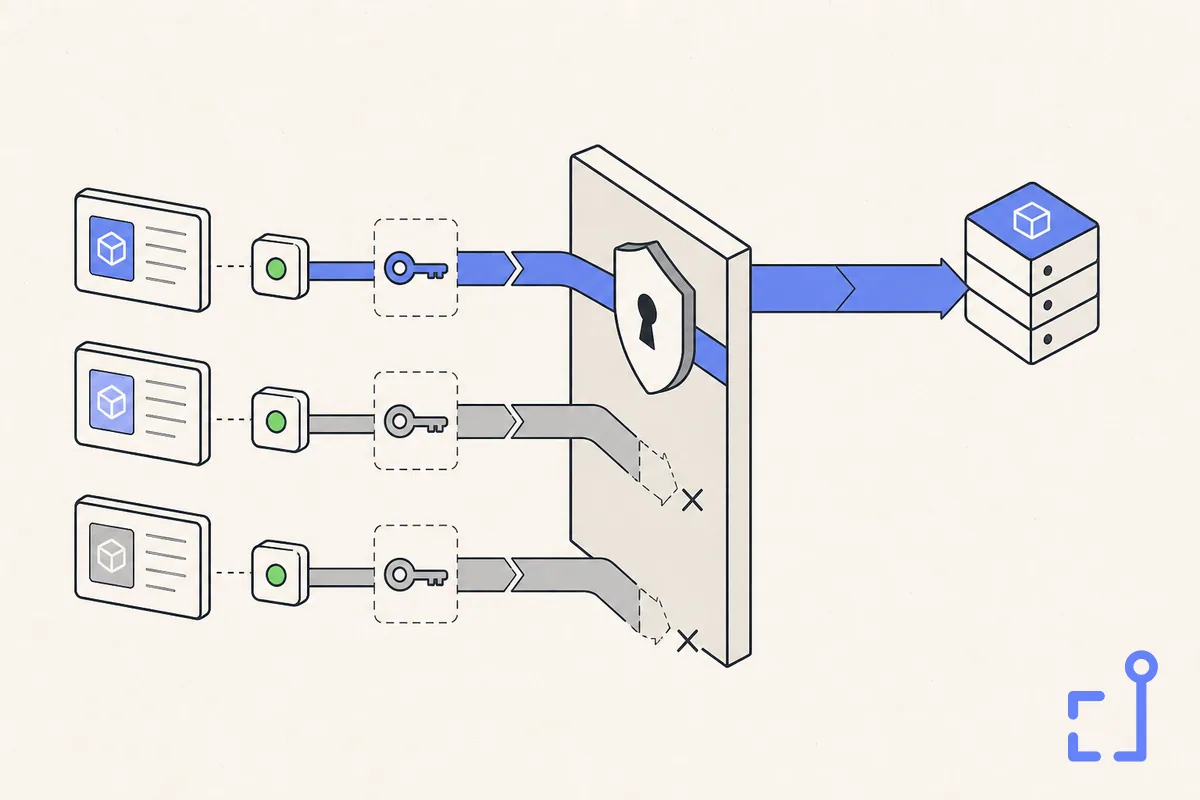
Digital asset rights enforcement must happen at the delivery boundary, not only in the user interface or when a signed URL is minted. A signature proves that a request was issued intact; it does not prove the asset is still licensed for this channel, territory, identity, tenant, or share. Re-evaluating current rights before every short-lived object-store redirect makes expiry and revocation apply to URLs already in circulation.
A rights badge is valuable communication. It tells a person whether the system expects a use to be allowed. It also gives them a place to inspect the reason. It becomes dangerous only when the architecture treats the badge as the control.
The simplest test is blunt: if somebody ignores the badge and calls the download route directly, what stops the bytes?
Every upstream check can be bypassed
Rights controls are often added where they are easiest to see. Those locations are useful, but none is sufficient on its own.
A badge is advice
A person can miss it, misunderstand it, or use another client. An API consumer may never render it. The colour cannot be the enforcement boundary because colour does not participate in delivery.
A disabled button protects one interface
If the underlying route remains callable, disabling the button changes the page rather than the permission. A user who has seen one delivery URL may also understand enough of its shape to construct another.
A handler-level check protects one route
A DAM has many ways to release bytes: a direct download, a share, a portal, a bulk package, a CMS rendition, a connector, or a transformed preview. If each route must remember to call a policy helper, the real policy becomes the set of routes whose authors remembered.
A signed URL can preserve the wrong decision
A signed token proves that the signed bytes were not altered. If the token contains allowed=true, the signature preserves a verdict made in the past. A licence withdrawn one minute later remains effectively valid until that token expires.
The safer interpretation is narrower: a signed URL is permission to attempt delivery under specific terms. Entitlement is computed from live state when the attempt arrives.
DAM rights enforcement needs one authorisation path
dam.rs routes downloads and renders through one delivery handler. The object bucket is private. The handler verifies the request and evaluates current policy. It then returns a presigned object-store URL with a 30-second lifetime. The application does not proxy large media bodies, but it controls the only supported path to a bearer credential that can fetch them.
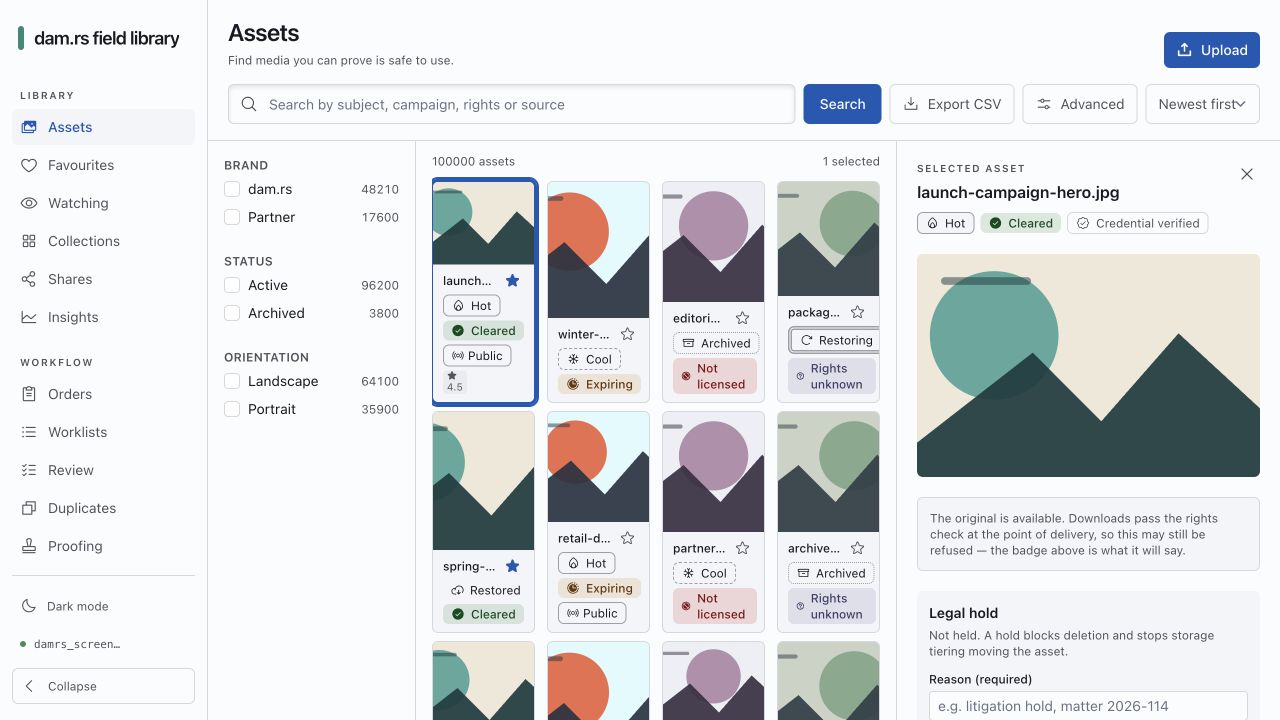
The asset inspector with representative development data. The green rights state explains the current verdict; the panel still states that delivery performs the authoritative check.
The order is deliberate:
- Verify the signature and token format.
- Refuse a token for another tenant.
- Re-check any share or connector state.
- Re-check identity access.
- Evaluate current rights for the signed channel and territory.
- Resolve the exact signed transform.
- Issue the short object-store redirect.
Checking rights before resolving the rendition also avoids an existence oracle. A caller with no entitlement should not learn whether a derivative exists by observing a different error.
The 30-second redirect is a concession, not proof of perfect revocation. AWS treats a presigned URL as a bearer token; once issued, the application cannot call that object-store URL back. The window is long enough for a browser to follow a redirect, but not for a person to reuse it later. Immediate revocation is therefore bounded by those seconds. The longer-lived dam.rs token is re-evaluated on every use.
This boundary-first approach is also useful outside media delivery. One Policy Gate for an Autonomous Agent applies the same idea to a different kind of sensitive action.
Carried terms, computed verdict
The distinction between carried and computed data is the core of the design.
The token carries facts about the request:
- tenant and asset identity;
- distribution or internal-preview purpose;
- requested transform;
- channel and territory;
- user identity, when present;
- share-link identity, when present;
- expiry and signing-key identity.
The token does not carry the effective rights verdict. That verdict depends on mutable records: licences, scopes, releases, legal holds, usage caps, membership, share revocation, and time.
The hardened claim type makes the boundary visible:
pub struct DeliveryClaim {
    pub tenant_id: Uuid,
    pub asset_id: Uuid,
    pub purpose: Purpose,
    pub transform: String,
    pub channel: String,
    pub territory: String,
    pub identity_id: Option<Uuid>,
    pub expires_at: DateTime<Utc>,
    pub share_link_id: Option<Uuid>,
    pub key_id: String,
}
Each signed field closes a concrete edit.
Transform prevents thumbnail escalation
If transform sits outside the signature, a caller can change thumb-256 to original. The signature still verifies because it never covered the part that selects the bytes.
Channel and territory select the contract terms
A licence can allow editorial use and refuse advertising. It can also allow one market while excluding another. Leaving those fields editable lets the caller select the rule under which the request will be judged.
Purpose prevents a policy downgrade
dam.rs distinguishes distribution from an internal preview. A signed-in tenant member may need a small proxy in the asset grid before a licence has been attached. That is internal cataloguing, not publication.
The exception is narrow. Internal preview requires a named identity, refuses share links, and permits only known proxy-class transforms. It can never request the original. Purpose is signed so a distribution request cannot be edited into InternalPreview to skip the rights verdict.
Share identity makes revocation reach issued URLs
Revoking a share page is not enough if that page has already minted delivery tokens. Carrying the share ID lets the delivery handler look up its current state. Revocation then affects outstanding tokens instead of waiting for their own expiry.
Tenant identity fixes the namespace
Asset UUIDs are meaningful only inside a tenant. A token without a tenant relies on deployment configuration to choose the schema and object prefix. Two deployments sharing a signing key can then accept each other's valid tokens. This can happen when staging is restored from production or a disaster-recovery site is activated.
If the same asset UUID exists in both libraries, the signature remains valid. The receiving deployment then resolves the wrong tenant's bytes. The clean audit trail is part of the problem: nothing looks forged.
The tenant now appears in the canonical signed payload before the asset ID. It is compared with the tenant served by the delivery process. A mutation test removes that comparison. The expected 404 becomes a 302, and the file is served. That test is worth keeping because it demonstrates the exploit, not only the intended branch.
The signature format has to preserve meaning
Signing the right fields is insufficient if two different claims can serialize to the same byte sequence.
A delimiter format can be ambiguous. If fields are simply joined with |, a value containing the delimiter can shift a boundary. Distinct claims may then render identically. The dam.rs token uses a version byte and length-prefixed fields. Distinct field sequences therefore produce distinct canonical payloads.
Token versions are refused rather than guessed. Adding tenant identity changed the meaning and layout of every field after it. Reading an old token under the new layout could interpret asset bytes as a tenant UUID. It could then shift the remaining bytes into plausible but false values. The signature would still match the byte string. It cannot tell the parser what those bytes meant when signed.
That is why a format version is a security field. When the layout changes, old tokens fail as WrongVersion. The maximum token lifetime is 24 hours. The compatibility cost is therefore bounded and smaller than supporting a layout that lacks a new security property.
HMAC comparison is constant-time through the subtle crate. The claimed key ID is used only to select candidate verification keys. It confers no authority before the MAC matches. A keyring retains retired keys long enough to verify outstanding tokens, while new tokens use the first active key.
Rights combination starts by choosing the applicable grant
An asset may have several licences and releases, but they are not automatically one intersected set. The evaluator first selects grants applicable to the requested territory, channel, purpose, asset version, and time. Independent grants are alternatives: one complete applicable grant can authorise the use. Restrictions inside the chosen grant, plus global policy such as legal hold or withdrawn consent, combine conservatively; an exclusion cannot be erased by a permissive field elsewhere.
The evaluator handles several rules that are easy to state incorrectly:
- Unknown rights deny distribution.
- An excluded territory beats a
WORLDinclusion. - A licence with no scopes grants nothing.
- A scope with an empty channel list means all channels.
- Legal hold blocks distribution as well as deletion.
- An expiring licence is a distinct verdict so renewal can happen before denial.
- Download and impression caps use an atomic reservation in the same transaction that authorises delivery. A read-then-check counter would oversubscribe under concurrent requests; failed transfers release or expire the reservation according to a recorded delivery outcome.
The exclusion order appears directly in code:
fn covers_territory(&self, territory: &str) -> bool {
    if self.excluded_territories
        .iter()
        .any(|t| t.eq_ignore_ascii_case(territory))
    {
        return false;
    }
    if territory.eq_ignore_ascii_case(WORLD)
        && !self.excluded_territories.is_empty()
    {
        return false;
    }
    self.territories.iter().any(|t| {
        t.eq_ignore_ascii_case(WORLD)
            || t.eq_ignore_ascii_case(territory)
    })
}
The second condition matters. A caller asking for WORLD cannot be satisfied by "worldwide except China." Checking only whether the inclusion list contains WORLD would turn an explicit exclusion into permission.
Refuse forgery and policy differently
A flat 404 is useful for malformed, expired, bad-signature, wrong-tenant, and revoked-share tokens. Telling an unauthenticated caller which component failed helps them refine the next attempt. It may also reveal whether an asset or share exists.
A rights denial is different. The caller is often an authenticated employee who can see the asset. They need to understand why distribution is blocked. Returning "not found" for an asset visible in the adjacent panel does not protect anything. It produces a support request.
dam.rs therefore returns a 403 with machine-readable rights state. Reason codes include no_license, legal_hold, expired licence, excluded territory, and disallowed channel. The UI can explain what needs correction without parsing prose.
The rule is:
- Collapse distinctions about existence until the caller is established.
- Explain distinctions about terms to a caller already entitled to inspect the asset.
That division also helps monitoring. A rise in signature refusals suggests scanning, clock skew, or key rotation trouble. A rise in rights denials suggests expired contracts or missing releases. It could also mean a client is asking for the wrong intended use. Combining them into one status would hide both diagnoses.
What this design costs
Every delivery performs indexed reads and policy evaluation before object-store I/O. Rights caches can reduce the work, but invalidation must fire on every input that changes the verdict. A stale cache is simply a carried verdict under another name.
The single delivery boundary also demands discipline. A future bulk exporter cannot read object keys directly because doing so is convenient. Connectors cannot mint unrestricted S3 URLs. The code review question for any feature that releases media is "where is its delivery claim?"
The internal-preview exception needs continued pressure. New transforms must not automatically become preview-safe. Anonymous access must remain distribution. A tenant-defined conversion may be small and still encode sensitive or full-resolution material. Only built-in profiles are accepted.
Finally, this is rights enforcement software, not legal interpretation. The system can apply terms it has been given. It cannot determine whether a contract was entered correctly or whether a jurisdiction recognises it. Nor can it decide whether the requested channel vocabulary matches counsel's intent. The data model makes those decisions enforceable; it does not make them for the organisation.
FAQ
Is a signed URL proof that an asset may be downloaded?
No. It proves that the signed request was issued and not altered. Current licence, release, access, share, tenant, and hold state still need evaluation when the URL is used.
Where should DAM rights enforcement happen?
At the point that authorises bytes to leave private storage. UI badges and issue-time checks should provide early feedback, but the delivery boundary must recompute the verdict.
How can rights revocation affect an existing URL?
The long-lived token carries request terms rather than an allowed verdict. Each use loads current rights and share state, so a lapse, withdrawal, or legal hold changes the response without changing the token.
Why allow previews of an unlicensed asset?
A freshly uploaded or migrated asset may need internal cataloguing before rights data is complete. A small, identity-bound, non-shareable proxy can support that work without permitting distribution of the original. The exception stays safe only because its purpose and transform are signed and narrowly constrained.
If ignoring the green badge still reaches the master, the product has a rights interface. It does not yet have rights enforcement.